Play-Based Therapy for Children with Autism in Toronto: How It Works and Why It Matters
Children learn through play. This is not a metaphor or a warm sentiment: it is one of the most well-supported findings in developmental science. From the earliest months of life, play is how children build language, form relationships, develop problem-solving skills, and learn to understand the world around them.
For children with autism, play is just as essential, and often just as natural. The difference is that the path into play can sometimes look different. When it does, that is exactly where therapy can help.
Amy Simon, the Senior Behaviour Therapist at Mini Minds, uses play as a primary therapeutic tool in her work with children across Toronto and the GTA. This post explains how that works, why it is particularly effective for children with autism, and what makes her approach different from both traditional ABA and play therapy offered in isolation.
What Is Play-Based Therapy for Children with Autism?
Play-based therapy uses structured or unstructured play as the primary medium for therapeutic goals. Rather than desk-based instruction, the therapist works within the child's natural play context: following the child's interests, embedding skill-building into activities the child already loves.
This is not "just playing." The child is engaged and having fun. The therapist is observing, guiding, and actively working toward specific, measurable goals. Every activity is intentional. The child simply does not know that.
In this approach, the toy is not the point. The toy is the vehicle. A puzzle session might be about developing joint attention. Stacking blocks might be about following two-step instructions. A favourite board game might be the setting for learning how to take turns, manage frustration, or start a conversation.
For children with autism, play-based approaches carry a specific advantage: they meet children where they already are. Rather than asking a child to adapt to a structured, adult-directed environment, play-based therapy brings the structure to the child's world. That shift makes an enormous difference in how engaged a child can be, and how quickly meaningful progress happens.
“Children don’t know they’re in therapy. They think they’re playing. My job is to know exactly which goals we’re working toward while we’re stacking blocks together.”
How Amy Integrates Play-Based Approaches with ABA at Mini Minds
The framework that makes this possible is called Natural Environment Teaching (NET). NET is an applied behaviour analysis (ABA) approach that embeds therapeutic goals into a child's natural activities and daily routines, rather than pulling them out of context into a clinical setting.
At Mini Minds, Amy uses NET as the connective tissue between play and therapy. The child's interests drive the activity. Amy drives the goals. In a session, this might look like following a child's lead to the train set, building the track together, and using that shared activity to work on language, social reciprocity, and turn-taking: all within a single 20-minute stretch that felt, to the child, like play.
What separates Amy's approach from play therapy offered in isolation is the precision. Every session has specific, documented goals drawn from a personalized behaviour plan. Progress is measured. Strategies are adjusted based on what the data shows. The warmth of play-based delivery does not come at the expense of rigour.
This approach sits within a broader ABA framework. For parents unfamiliar with ABA methodology, our guide to ABA therapy in Toronto provides the full context.
Why Play-Based Therapy Works So Well for Children with Autism
Research consistently supports naturalistic, child-led instruction as highly effective for children with autism. Studies across developmental and behaviour analytic literature find that children learn new skills more efficiently when instruction is embedded in activities they find motivating, rather than in isolated, adult-directed trials.
The mechanism is well understood: engagement drives learning. When a child is genuinely interested in what they are doing, they are more attentive, more responsive, and more likely to generalize what they have learned across different settings and situations. This is particularly important for children with autism, for whom skill generalization can be one of the more challenging aspects of development.
Play also reduces the demand context that can trigger avoidance or distress in some children. In a structured, desk-based session, the therapeutic goal is visible and the pressure to perform is felt. In a play-based session, the child is simply doing something they enjoy. The therapy is happening; the child is not self-conscious about it.
For children at the earlier stages of social communication development, play provides the single most natural context for those skills to grow. Shared attention, imitation, turn-taking, cause-and-effect exploration: all of these emerge most readily in play, because that is what play is for.
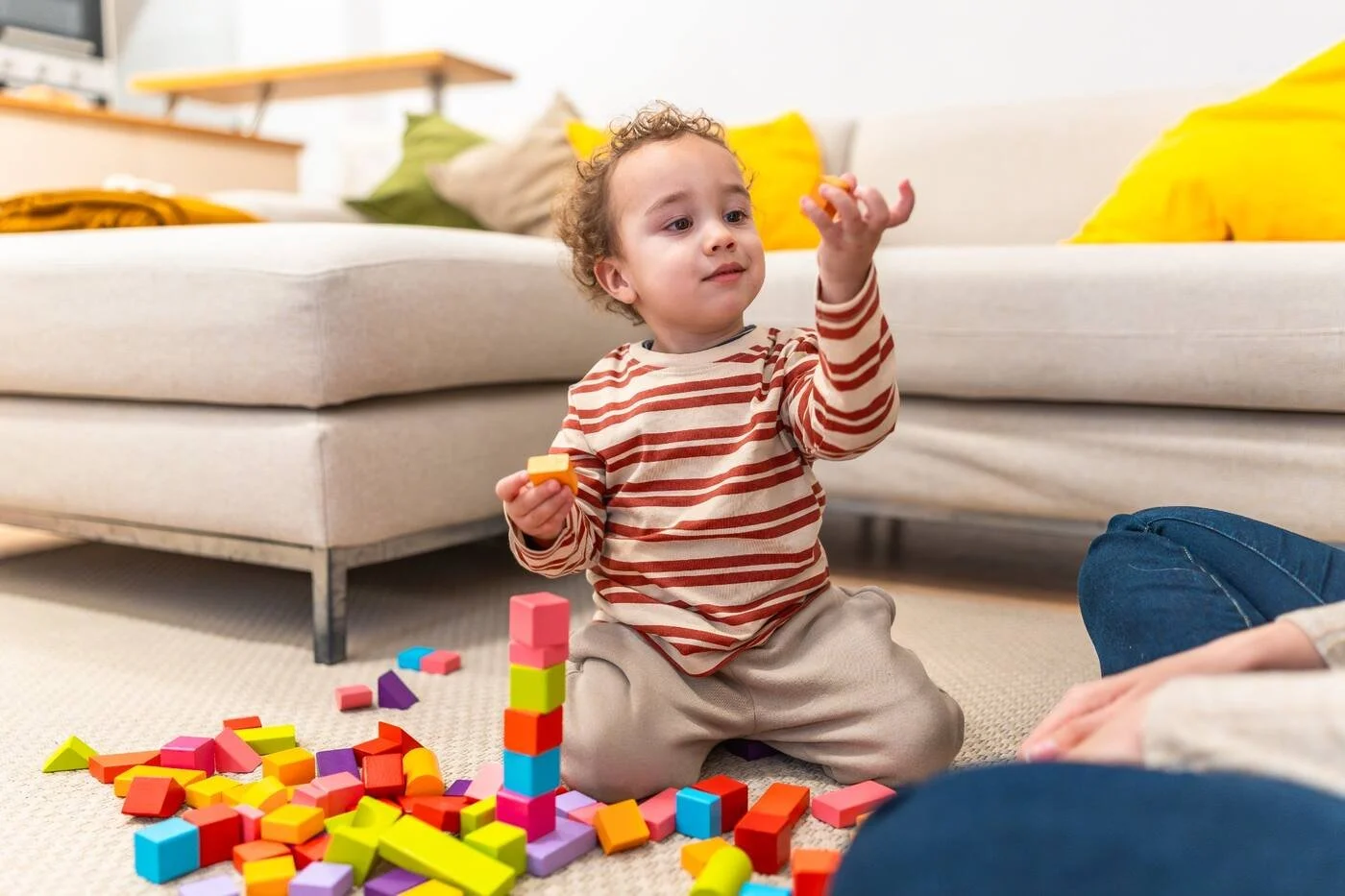
Play-based therapy at Mini Minds happens in your child's world, with the toys they already love.
What Play-Based Therapy Looks Like at Different Ages
Play-based therapy adapts to the child, not the other way around. What it looks like in practice changes significantly depending on where a child is developmentally and what they love to do.
Here is what a typical session with a three-year-old might look like:
"We're building with Duplo. He wants to knock it down. I let him. Then I rebuild it, hand him a piece, and wait. He looks at me. That moment of shared attention: that's the goal we've been working toward for three sessions."
That shared glance, that brief meeting of eyes, is called joint attention. It is a foundational social communication skill, and it emerged naturally, in a moment of playful connection, not from a drill.
For children aged two to five, sessions typically focus on naturalistic play, sensory activities, and child-led exploration. The therapist follows the child's pace and interests, embedding language and social goals into unstructured play.
For children aged six to ten, the approach shifts toward cooperative games, creative projects, and activities that involve shared goals. Peer interaction skills become more prominent in the work.
For older children (ten and up), interest-based activities take centre stage: building things, art projects, structured social play in contexts that feel natural and motivating. The goals become more nuanced, but the principle stays the same: meet the child where they are, in what they love.
Play-Based Therapy vs. Traditional ABA for Autism: What Parents Need to Know
One of the most common misconceptions parents encounter when researching autism therapy is that play therapy and ABA are opposites: one is warm and natural, the other is clinical and rigid. This framing is both unhelpful and increasingly outdated.
The distinction that actually matters is not play therapy vs. ABA. It is the question of how therapy is delivered. Desk-based, discrete trial ABA and naturalistic, play-based ABA are both grounded in applied behaviour analysis. The difference is in the setting, the structure, and who leads the activity.
Here is how they compare:
| Factor | Traditional Desk-Based ABA | Play-Based ABA (Mini Minds) |
|---|---|---|
| Session setting | Structured table or desk | Child's natural environment (home, yard, school) |
| Who leads activity | Therapist | Child (with therapist guiding toward goals) |
| Child engagement | Variable — depends on child's motivation for structured tasks | High — based on the child's own interests |
| Skill generalization | Requires deliberate transfer to natural settings | Built in — skills emerge in real-life contexts |
| Best suited for | Specific skill acquisition, older learners with strong task tolerance | Young children, early social and communication goals, children who disengage from structured tasks |
For older children and adolescents, Amy often integrates cognitive-behavioural approaches alongside play-based work, particularly for anxiety, emotional regulation, and managing the social demands of school. Our guide to CBT for autistic children explains how the two approaches complement each other.
How Parents Can Support Play-Based Learning at Home
One of the advantages of in-home therapy is that the skills a child is working on with Amy are the same ones they can practice in everyday life. Parents do not need to run formal sessions; they need to understand the principles.
Amy works closely with every family she supports. The strategies she uses in sessions are translated into simple, practical guidance that parents can carry forward at home, making the work that happens in therapy part of everyday life.
- 1 Follow your child's lead. Let them choose the activity. Sit beside them rather than directing. Your presence and attention are themselves therapeutic.
- 2 Wait before you speak. When your child reaches toward something or looks at you, pause before filling the silence. That pause creates space for communication to grow.
- 3 Celebrate small moments. A shared look, a new word, handing you a toy: these are real developmental steps. Name what you see: "You gave me the block! Thank you." Narrating small wins reinforces them.
Play-Based Therapy in Toronto and the GTA: How Mini Minds Delivers It
One of the most significant advantages of play-based therapy is that it works best when it happens in the child's own environment. Familiar toys, familiar spaces, a familiar routine: all of these make it easier for a child with autism to engage, and make the skills they develop more likely to generalize into real life.
At Mini Minds, therapy is delivered in the home. Amy brings the approach directly to your child's world, which means the train set in the living room, the slide in the backyard, and the colouring books on the shelf are all potential therapeutic tools.
Mini Minds currently serves families across all Toronto neighbourhoods as well as the broader GTA, including Markham, Pickering, Ajax, and Whitby.
Delivering therapy in the home environment is a cornerstone of how Mini Minds works. Our guide to in-home ABA therapy explains the approach in full detail.
If you are ready to take the first step, we would love to hear about your child. Book a free consultation today.
FAQs About Play-Based Therapy for Autism in Toronto
What is play-based therapy for autism?
Play-based therapy for autism uses play as the primary medium for developing communication, social, and learning skills. The therapist follows the child's interests and embeds therapeutic goals into activities the child finds naturally motivating. At Mini Minds, play-based delivery is integrated within an ABA framework, which means goals are specific, progress is measured, and sessions are adapted based on each child's individual plan.
Is play therapy effective for autism?
Yes. Research supports naturalistic, play-based instruction as effective for children with autism, particularly for early social communication skills, language development, and engagement. Play-based approaches help children learn in contexts that feel natural, which also improves their ability to apply new skills in everyday situations.
What is the difference between play therapy and ABA therapy?
The two are not mutually exclusive. Play therapy and ABA differ primarily in their delivery model. Traditional ABA uses structured, adult-directed instruction. Play-based ABA (including Natural Environment Teaching) embeds the same evidence-based goals within child-led, naturalistic play. At Mini Minds, the distinction is not "play or ABA": it is about using play as the delivery mechanism within a rigorous behaviour-analytic framework.
What age is play-based therapy most effective for children with autism?
Play-based approaches are particularly effective for young children aged two to seven, when foundational skills in communication, social interaction, and play development are the primary focus. That said, play-based principles can be adapted for older children and adolescents based on their individual interests and goals.
Can play-based ABA therapy be done at home?
Yes, and at Mini Minds, it always is. Amy delivers all therapy in the child's home environment. This is a deliberate choice: in-home therapy means the child is comfortable, the environment is familiar, and the skills being developed are immediately applicable to daily life. For more on how this works, visit our full FAQ page.